Lauraine’s blog
14 December 2013
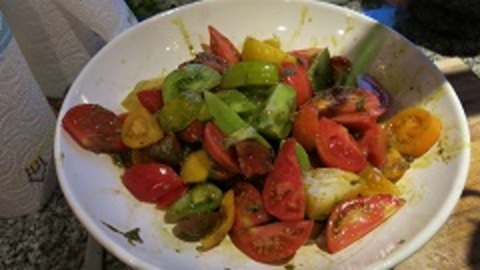
In March this year I was served a tomato salad. At the time I posted a story about that here. (Scroll back to 11 March if you must.) I wrote that the salad was "almost life-changing."
Thanks Darren Lovell for sharing your tomatoes from the Fishbone Farm. There were about fifteen varieties of tomato, all chopped up and dressed with a mixture of pounded basil, some salt-cured anchovies and some fine extra virgin olive oil. Absolute bliss, and if anyone, anywhere, anytime has ever had a finer tomato salad I don't believe them!
Look for his tomatoes on the menu at Fishbone in Queenstown later this summer. They are worth the plane fare to Queenstown, I guarantee.
13 December 2013
Yesterday I hosted a Japanese food writer and her photographer from the Japanese magazine ELLE AT TABLE. We ate lunch at Soul Bar on the terrace, underneath those amazing baskets of hanging flowers, overlooking the Viaduct Basin on a calm summery day. I cannot think of a better way to show Auckland's finest attributes.
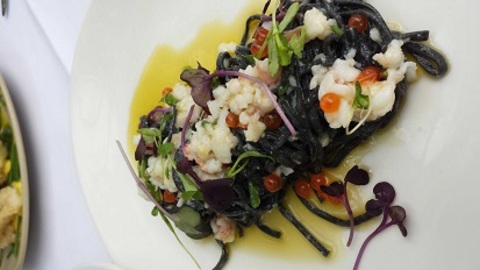
We ate omakase style; the owner Judith Tabron picked the dishes for us and sent out kingfish, tuna, snapper, salt and pepper squid, goat cheese ravioli and whitebait fritters. But the star of the show (despite the fact that the Soul kitchen churns out more than 450 portions of that squid a week) was the dish pictured above.
Scampi on squid ink pasta with salmon roe and micro greens. Perfection! if you're headed to Soul over the next few days, do not miss this delicate and yet tasty dish. I really lucked out for the S Day! Squid ink pasta, Scampi and Soul. Very sibilant.
12 December 2013
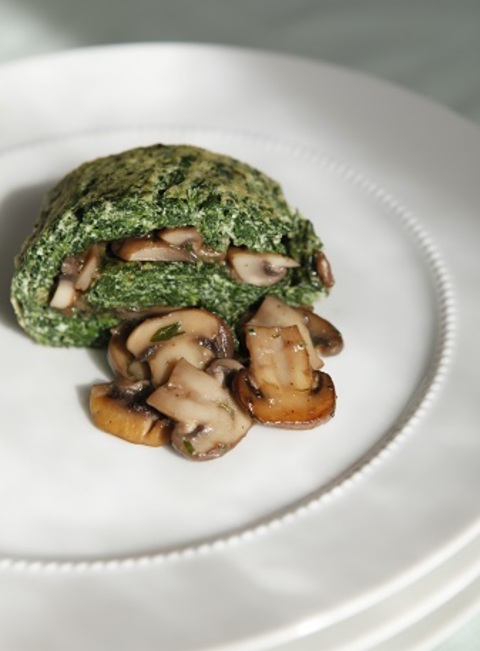
My spinach roulade has been a saviour on many occasions. It is the perfect dish to serve vegetarian guests, it is a light and easy entrée to rustle up. We made something similar way back during my Cordon Bleu training and I have made it one of my regular repertoire recipes. (All r's note.) The recipe is in my book, Everlasting Feast and also online at The Food Hub.
The other roulade I could not do with out is a fancy chocolate roulade, filled with whipped cream, iced with rich chocolate icing and served with seasonal berries. It's a must at our family Christmas Table and my mother makes it for us every year. That recipe is also on the Food Hub and in my book.
the other roul
11 December 2013
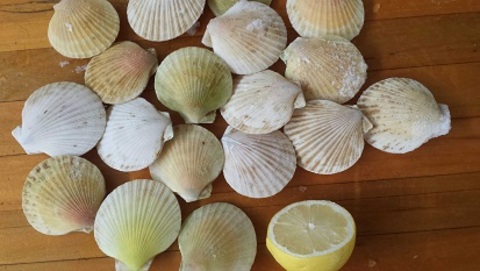
Queen Scallops are rarely found outside restaurants but they're so good they are exported to several markets around the world .
Harvested wild off the coast in the chilly waters of the southern of the two main islands of New Zealand they are generally available in 1 kg bags of free flow frozen form. This doesn't change the flavour at all.
To prepare them simply place the queen scallops in their shells (no need to clean or purge them) on a grill or add them to a seafood stew. They are a real delicacy with a subtle sweet flavour.
To purchase try the frozen section of a good seafood retail store or send enquiries to Southern Clams.
10 December 2013
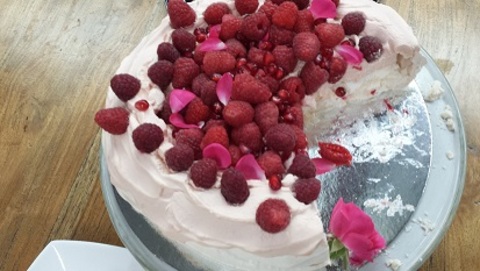
This is the stunning rosewater and pomegranate pavlova which won the 'alternative' section of the NOSH gourmet store pavlova competition last week. It was absolutely superb; I know as I was one of the judges and was stunned to learn it had been made by Claudia Frew, a pupil of Epsom Girls Grammar. She beat over forty other contestants, some of whom were up to four times her age.
The Aussies may think the pavlova is their invention but former professor of anthropology at University of Otago, Helen Leach meticulously researched hundreds of community and professional cookbooks and proved conclusively the pavlova was being made in New Zealand well before Anna Pavolva ever danced for Bert Sachse in Western Australia.
The ideal pavlova has a crunchy exterior, while the middle must be marshmallow-like. Needless to say, whipped cream is an essential topping and some fruit, maybe passionfruit, kiwi fruit or fresh berries finish it off.
9 December 2013
Oranges are one of my most favoured fruits. But they have to be great oranges, such as the delicious Kerikeri or Gisborne oranges that are juicy and sweet while they are in season. As they ripen during the winter months, I find a couple of oranges a day keep the flu and winter colds at bay!
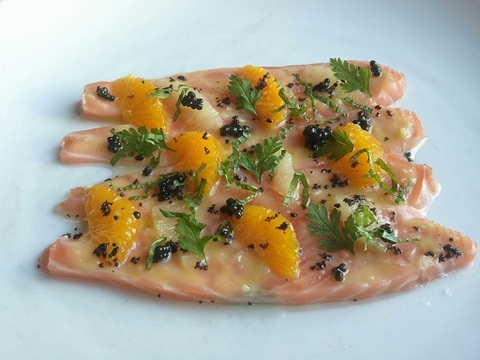
Oranges are terrific to add to dishes both savoury and sweet. As in this beautiful dish, enjoyed by me when Hayden McMillan was cooking at Tribeca (before he found fame in San Francisco at the Waiheke Island Yacht Club) is garnished with caviar, herbs, lemon and most importantly, perfect orange segments. The orange lent a wonderful mixture of sweetness and acidity to the fresh slices of delicious Ora King Salmon. It was superb.
When making orange segments it is essential to peel all away every single scrap of both skin and pith with a sharp knife. I find the best way to do this is to hold the orange very lightly in my left hand, and cut with a sawing motion around and around the orange. I end up with a lengthy piece of orange peel and as I go round I can catch any small pieces of white pith so the segments end up sparkling clear, just like those that Hayden produced in his dish here.
These segments are also brilliant in salads, desserts and for topping fish and chicken dishes.
8 December 2013
Italian, Chinese and Japanese cuisines are possibly the most recognised for ways with noodles. What would Italian fare be without spaghetti and the myriad other derivatives of both dried and fresh pasta noodles? Chinese egg and rice noodles are one of life's pleasures too. (Suffice to say I am not going to write about 'instant' noodles, despite their universal popularity. Yuk!)
But for me it is the array of noodles in Japanese eating that is supreme. You haven't tried Japanese food until you have experienced really good ramen, and for many Japanese a bowl of warming noodles in a light tasty broth makes the perfect lunch. Whether it is rice, buckwheat, udon or egg noodles they are essential to everyday eating in Japan.
I once stayed at Ryokan Sakamoto on the Noto peninsular which juts out into the Japan sea, well north of Tokyo. It was one of those life changing experiences with sensational food and exquisite style. While we were there the first harvest of the season's buckwheat arrived and it was inspiring to see the reverence with which Sakamoto san treated his heavy sackful of tiny seeds. He was, and still is, a master of soba noodle making and I cannot ever hear or read the word soba without thinking of this extraordinarily gifted but humble man.
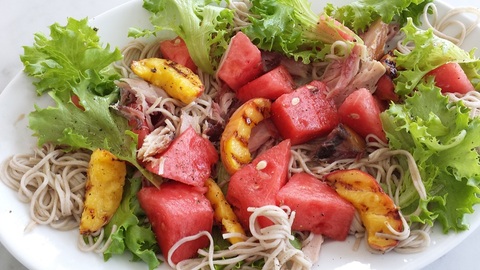
My lunch salad today, pictured above is a intriguing combination of salted watermelon, smoked mackerel, grilled peaches, crisp lettuce and of course, cold soba noodles. It was delicious.
7 December 2013
Mustard is one of those essential storecupboard/fridge ingredients that cooks like me rely on to add an extra shot of flavour and to lift the taste in a variety of dishes. Right now, with Christmas looming, I am stocking up on mustard as it is the perfect accompaniment to the season's festive ham. I'm a real fan of Dijon mustard as it is smooth, only a little peppery and has a true mustard taste.
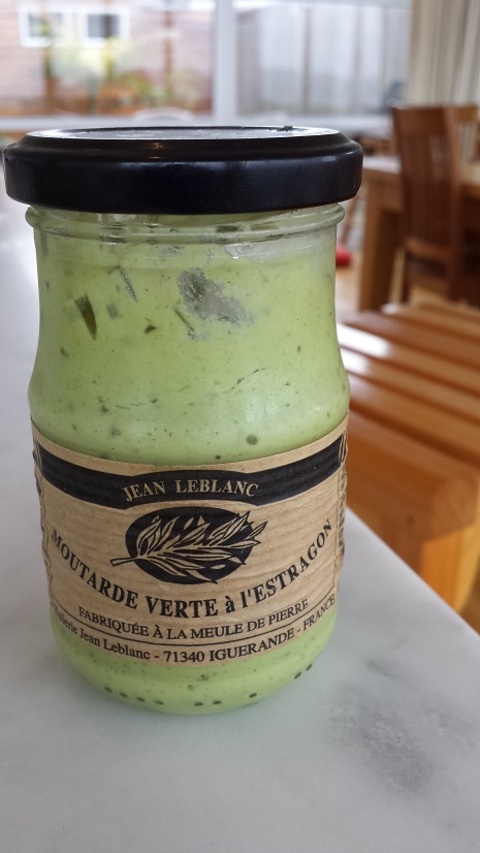
When in Paris recently we found a little gourmet store, Le Tomat tucked into a courtyard at 12, rue Jacob in the 7eme. It was filled with all sorts of those hard to find artisan food products that have been carefully collected and displayed. I bought a tiny selection to bring home in my luggage and my first choice was a small jar of green tarragon mustard. It is deliciously perfumed with tarragon and is going to be perfect to add to vinaigrettes over the summer months.
Needless to sat, it lurks well to the back of the shelf in the fridge as I am jealously guarding the jar and only bringing it out when I know it's going to be appreciated.
6 December 2013
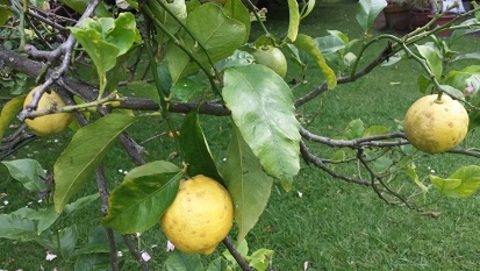
In the list of questions journalists ask a foodie it is guaranteed that somewhere
"What are your favourite ingredients?" will pop up. My answer always begins with lemons (then salt, herbs and butter in that order) and I defy any foodlover to even begin to imagine life without lemons.
Lemons bring freshness, a drop of acidity and a tantalising perfume to every dish they are added to. A golden rule however is to make sure you add the lemon juice at the very end of the preparation of your cooking, just before serving, as the freshness will dull over time and that jolt of sparkling flavour will be lost.
I have a lemon tree in my garden that was here when we moved in 38 years ago. It has been a magnificent friend over all those years, reliably producing a crop of juicy tart lemons year round. It has suffered from borer, had its limbs pruned and twisted and is now only a shadow of its former self, gnarled and curled like a very old woman. But I prop it up and it keeps on rewarding me. I love that tree with all my heart.
5 December 2013
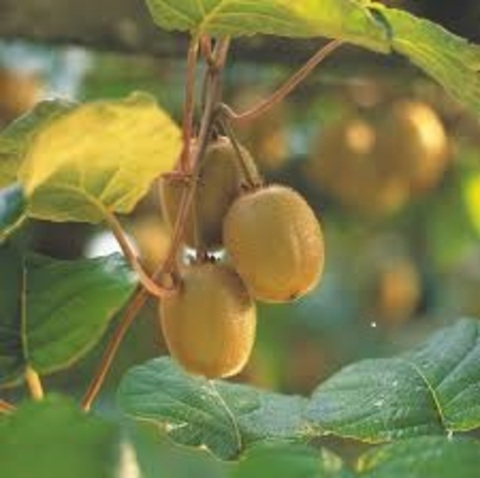
I grew up in a home that had a field of kiwifruit vines on the boundary. We would sneak over the stone walls to help ourselves to a feast of 'Chinese Gooseberries' as they were named at that time. The old ladies who lived next door were more than happy as they had little use for them.
A few years later a smart marketer renamed these furry fruit 'Kiwifruit', exported them around the world and made them one of the stories of riches upon which we built the nation.
As we call ourselves Kiwis we're often the butt of jokes, but there's no denying that a Kiwifruit in prime condition is a thing of beauty. Cut in half it reveals its inner secret - a delicate web of black seeds arranged in concentric circles. Ideal for topping a pavlova or for adding a splash of green to a fresh fruit salad. Even better, just peel and enjoy; the sweetness and acidity are in perfect balance.